Sunday, November 24, 2013

Story Cube

From time-to-time students will need a hand to help them with their reading comprehension. This where the Story Cube can come in "hand-y". (sorry, couldn't help the pun.)

Using an empty tissue box, some craft sticks and blank paper cut into the shape of hands, the story cube can be twirled and then a hand is selected (for one-on-one work) or the story cube can be passed along the small group to choose a hand to answer comprehension questions. The story cube can also be great for whole class setting as each hand is pulled from the cube, another stick can be pulled for the student that will be chosen to answer the question.

The students had a blast creating the story cube together. The comprehension questions were predetermined by our standards, but the students picked the colors, wrapped, glued, etc. When it was done it was not only a tool in our classroom for reading, but the students had ownership since it was a fruit of their labor. It has become a tool certainly more used than one that I would have purchased.

"When the students have ownership they will use it more."


Wednesday, April 17, 2013

Getting ready for standardized test.... In Kindergarten!

The Standford Assessment Test or SAT-10 as it is referred to locally will be in two weeks. We have been preparing since the beginning of the school year, but as we get closer to the event we tend to be a bit anxious to make sure we have prepared everyone sufficiently.

As I have reviewed the practice test, worked with the format and teaching how to listen better, how to read key words and other testing strategies I cannot help but feel that we are really preparing students for an educational life of standardized testing. Since we are starting now in Kindergarten these students will continue to be tested through each grade, their ACT, GRE, etc., etc. is this good? Will we actually be able to reduce testing anxiety? Will the continuous testing just become a natural part of education and become so much a part of the school year that it will loose this anxiety facing us?

I can only hope.


Saturday, March 2, 2013

Happy Birthday, Dr. Seuss!


Dr. Seuss has inspired so many readers both young and old.
Here are a few quotes that have inspired me over the years and I've shared with my classes. They should be read periodically, not just on his birthday, but on those days you just need a good change i your view, a paradigm shift, or just a broad smile. 

  1. Congratulations! Today is your day!
  2. Be who you are and say what you feel because those who mind don’t matter and those who matter don’t mind.
  3. Don’t cry because it’s over. Smile because it happened.
  4. Only you can control your future.
  5. So the writer who breeds more words than he needs, is making a chore for the reader who reads.
  6. The more that you read, the more things you will know. The more that you learn, the more places you’ll go.
  7. Today is gone. Today was fun. Tomorrow is another one.
  8. Today you are You, that is truer than true. There is no one alive who is Youer than You.
  9. Unless someone like you cares a whole awful lot, nothing is going to get better. It’s not.
  10. You have brains in your head. You have feet in your shoes. You can steer yourself, any direction you choose.
  11. You know you’re in love when you can’t fall asleep because reality is finally better than your dreams.
  12. All alone! Whether you like it or not, alone is something you’ll be quite a lot.
  13. I’m afraid sometimes you’ll play lonely games too, games you can’t win because you’ll play against you.
  14. You can get help from teachers, but you are going to have to learn a lot by yourself, sitting alone in a room.
  15. So be sure when you step, Step with care and great tact. And remember that life’s A Great Balancing Act.
  16. Words and pictures are yin and yang. Married, they produce a progeny more interesting than either parent.Be awesome! Be a book nut!
  17. If you’d never been born, then you might be an Isn’t! An Isn’t has no fun at all. No, he disn’t.
  18. Why fit in when you were born to stand out?
  19. You are you. Now, isn’t that pleasant?
  20. You’re in pretty good shape for the shape you are in. I have heard there are troubles of more than one kind. Some come from ahead and some come from behind. But I’ve bought a big bat. I’m all ready you see. Now my troubles are going to have troubles with me!
  21. I’m sorry to say so but, sadly it’s true that bang-ups and hang-ups can happen to you.
  22. It’s a troublesome world. All the people who’re in it are troubled with troubles almost every minute. You ought to be thankful, a whole heaping lot, for the places and people you’re lucky you’re not.
  23. Christmas doesn’t come from a store, maybe Christmas perhaps means a little bit more …
  24. A person’s a person, no matter how small.
  25. I know, up on top you are seeing great sights, but down here at the bottom we, too, should have rights.
  26. Kid, you’ll move mountains!  Today is your day! Your mountain is waiting. So…get on your way!”
  27. Fantasy is a necessary ingredient in living, It’s a way of looking at life through the wrong end of a telescope. Which is what I do, And that enables you to laugh at life’s realities.
  28. From there to here, and here to there, funny things are everywhere.
  29. I like nonsense, it wakes up the brain cells. Fantasy is a necessary ingredient in living, It’s a way of looking at life through the wrong end of a telescope. Which is what I do, And that enables you to laugh at life’s realities.
  30. If you never did you should. These things are fun and fun is good.
  31. I’m glad we had the times together just to laugh and sing a song, seems like we just got started and then before you know it, the times we had together were gone.
  32. It is fun to have fun, but you have to know how.
  33. Look at me! Look at me! Look at me NOW! It is fun to have fun, but you have to know how.If things start happening, don’t worry, don’t stew, just go right along and you’ll start happening too.
  34. I’m sorry to say so but, sadly it’s true that bang-ups and hang-ups can happen to you.
  35. Things may happen and often do to people as brainy and footsy as you.
  36. Oh, the things you can find if you don’t stay behind!
  37. There’s no limit to how much you’ll know, depending how far beyond zebra you go.
  38. Today is your day! Your mountain is waiting. So… get on your way.
  39. Unless someone like you cares a whole awful lot, nothing is going to get better. It’s not. And will you succeed? Yes indeed, yes indeed! Ninety-eight and three-quarters percent guaranteed!
  40. If you keep your eyes open enough, oh the stuff you will learn. Oh the most wonderful stuff.
  41. It’s opener, out there, in the wide, open air.
  42. Just tell yourself, Duckie, you’re really quite lucky.
  43. You’ll miss the best things if you keep your eyes shut.Sometimes the questions are complicated and the answers are simple.
  44. In the places I go there are things that I see that I never could spell if I stopped with the Z
  45. Think left and think right and think low and think high. Oh, the things you can think up if only you try!
  46. How did it get so late so soon? Its night before its afternoon. December is here before its June. My goodness how the time has flewn. How did it get so late so soon?
  47. They say I’m old-fashioned, and live in the past, but sometimes I think progress progresses too fast!
  48. Think and wonder, wonder and think.
  49. Simple it’s not, I am afraid you will find, for a mind-maker-upper to make up his mind.
  50. You’re on your own. And you know what you know… And YOU are the guy who will decide where to go.

Thursday, January 17, 2013

A Pirates Life for Me!

My Kindergarten neighbor asked for assistance in motivating one of her students who just wouldn’t do any of the work she assigned to him. So she asked if I would observe him. I agreed, but I wanted to have him come to my room with work and let me observe him in my setting without distractions.
We worked on identifying items which started with the letter W – “worm” was one of the first pictures. My opening line was, “Do you eat worms?”
He looked at me like I was asking the dumbest question in the world. “No, “ he said. Then thinking, “unless they are gummy worms. I do eat them,” he concluded.
So he then immediately jumped from worms, to swordfish and pirates. I don’t understand the synapse link, but then he is in kindergarten and the mind works very fast.  We talk for awhile about swordfish and pirates. How the pirates would take the swords off the swordfish and use them. Even removing their eyeballs from the fish and using the socket to put their thumbs to hold onto the swords when they were fighting.  He went into great details.
At this point I now knew what we needed to do to help him with his work. He had no desire to work unless he had a motivator and pirates would be his motivator.
I told him that I had would look up a video on pirates if he would complete the work his teacher had left with us. Faster than, “shiver me timbers” his was working on the “W” sounds and had completed (with accuracy) all of the work and his hand was flagging me down as I moved from student to student. He didn’t shout he just waved. I checked his work and gave him a “high in the sky” hand slap (high fives can be confusing during math, so we use the other phrase.) We then moved to another table, I pulled out my iPad and found a movie trailer from Pirates of the Caribbean and we watched it together. He was mesmerized.
Not to lose the moment, we went back over to his regular classroom and he showed me the other work he needed to do. It was a lot, but I told him that if he would work and get it all done, correctly, I would read him a book that I had about Pirates and searching for gold (actually, A Pirates ABC’s). He did.
I checked the work, he did great. We came back to my classroom, we read with others in my class, but he got to point out items in the pictures about the pirates, the pirate ship and to call out the letters the crew and found on the island and in the ocean.  Then we were done.  He needed to have a continual motivator. He had only read the book once and wanted to read it again.
I said, “how about we take the book back to your classroom. Give it to your teacher, and when you have done your work and awaken from your nap, you can read it again, all by yourself.  He agreed. We did.
At the end of the day I visited to see how he had done. Teacher said he was a different child. He finished his work with fewer prompts the rest of the day and at the end of the day he had earned the reward to look at the book alone. Before leaving, he placed the book on the teacher’s desk and stated, “I will want to read it again.” To which she stated, “as long as you continue to do your work, then you can read it again, and again.”
I will check on him in the morning and make sure that he remembers.
Our favorite letter in the whole book? “Rrrrr,” of course.

|D|

Sunday, December 9, 2012

Tips for dressing a sensory sensitive child


Karen Wang, a parent, posted on the FriendshipCircle.org blog a great article entitled "10 Tips for dressing a sensory sensitive child".   


The article is helpful to parents and educators alike as the parents choose clothing and as the educators work with sensory sensitive students. Check out the complete article here


Mr. DDon

Helping Students to Name their colors!


Why Johnny Can't Name His Colors

The kid's are probably not color blind. Melody Dye has a great article and a trick for teaching children colors at a younger age--and why it is otherwise so hard for them. Check out the article: "Why Johnny Can't Name His Colors"  then remember what she has written. It is such a simple change for us to teach students, parents and others when talking about colors. 

|D|

Saturday, September 29, 2012

Great blog for "Little Minds"

Check out Tara's "Little Minds at Work" blog --- she has some great ideas and useful information for Kindergartners and other ages as well.  

I liked her information on Phonemic Awareness so I'm going to set the link for it:  http://littlemindsatwork.blogspot.com/2012/07/phonemic-awareness-and-phonics-101.html

Check out her blog today!

|D|

Saturday, September 15, 2012

Some of the best sayings...

       Each day that we work together my students will come out with certain phrases or questions that will just cause me to stop and laugh out loud.  I don't laugh at them as much as I laugh at the learning process. We all have processing delays, languishes, misunderstandings and yet we don't seem to express them quite as openly as my wonderful exceptional students in Kindergarten and First Grade. They are without filters and therefore we must take caution in how and what we say -- no matter whether it's in the classroom, the playground, the cafeteria, talking with other adults but within earshot of the students and especially cautious at home and from the media. They will learn and process back to us from all of the input they receive.

Here are some of the gems of this week... 

1. We are going to celebrate when we reach five days of 100% positive behaviors. We use www.classdojo.com to record our positive and negative behaviors. Each of the students see their individual scores and our daily percentage when we close out the day just before dismissal. On the day we reached our 3rd 100% day I posted a sign of the fast food choices for lunch, we could select, once we reached our 5th day. Wanting to use social studies as the lesson, I said we would take a "vote" on where we would choose for lunch.  Immediately one of the students raised his hand and emphatically stated, "I'm afraid of boats, please let's not take a boat. You just go through the drive-thru and bring it back, okay?"


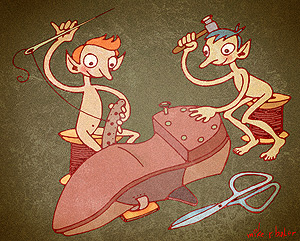
2. We have been using fairy tales, nursery rhymes and fables as our reading materials to help the students be able to sequence events, identify characters, setting, select the hero and the villain. After we had read the "Shoemaker and the Elves" and then watched the book on video, I started asking questions about the story. All of the students were participating and raising their hands to answer the questions. We were all fully engaged on the story's setting, subject, actions, and characters. However, when I asked the question as to why the Shoemaker and his wife wished to make clothes for the Elves, a student who had not participated as much as the others quickly raised his hand. "Yes?" said I. "Oh, they wanted to make clothes for them since the Elves were butt naked!"

3. We were working on math stories in order to practice our addition and subtraction. I had made power point slides that were pretty sophisticated and the students were excited to see apples fall from the tree, to see the equation appear as they read the narrative of the math story. My last slide was one where three race cars were lining up at the starting line to run a race. Before we could read the first line of the story one of the students raised his hand and stated that his dad says that "race cars go so fast that it makes you pee on yourself."

4. When studying foods that we can eat without cooking, I chose to sing the song, "Herman The Worm" where Herman grows a little bit after eating each item the student says and then at the end he returns to his original size, because he "burps". Boys love it because the song involves sitting a fence post, chewing bubble gum, playing with my yoyo... but as we had moved around the table one morning, singing the song and stopping for each of them to state a food you can eat without cooking, one of my students on the autism spectrum was not very talkative. I repeated the phrase again, no response. I then gave him a verbal cue to see if he would repeat the cue, but again no response. One of my other students sitting next to the first one immediately stands, garners a look of terror on his face and points to the other student shouting, "Broken, Mr. Don, broken!"  Not loosing a step, I reached over the the student on the autism spectrum, touched the button on his shirt, restated the verbal cue, to which he then responded clearly, "carrots". The other student sat back down and stated, "Thanks, Mr. Don." We just moved on with another round of the song until all had a chance to participate. I smiled and winked at the one who was concerned about his classmate. He gave me a thumbs up!


|D|


Sunday, August 26, 2012

The Teaching Must Go On!


We started school on August 1, 2012. Earlier than ever before and on August 15, 2012 I had a fever of 102.5.  I had had the chills and just thought the a/c had finally kicked on or that the temperature outside had dropped.  But after my assistant told me that I was "beet red" I decided that either my blood pressure was sky high or I had a fever. 


After a visit to the school nurse, she confirmed 
that I had a fever and that it 
was 102.5 and immediately 
she said, "You have to leave school." 
I was devastated. Not only was I sick and didn't know it, but I was not liking the fact that I had to leave. We were making such great progress... we had been having a great lesson and was continuing to have the students engaged after lunch. They really wanted to know about the "Tortoise and the Hare." 

When I came back from the nurse, I told my assistant about the temperature and that I would be leaving. The sadness I had on my face must have been obvious. Even the students were getting confused as I tried to not get too close so I wouldn't infect them with whatever was going on with me.

I had lesson plans for the entire week already done and in the folder. But having to show them, explain them and get emails and other things done so I could exit the building didn't get transmitted as well as I would have liked. 

After visiting the doctor later in the afternoon, he concluded, after tests and a chest x-ray that I had walking pneumonia and needed immediate and strong antibiotics along with complete bed rest. I was not to go back to work until Monday. He told me the fever probably wouldn't be under control until Saturday or Sunday. This was Wednesday afternoon -- two entire days without seeing my kids? We had been clicking along and they were so engaged that you just felt everyone one was learning and enjoying the lessons as well. We had been having a fun and they were engaged in the material so much they were generating questions they hadn't been able to pose before. It was truly great and now I already feel the loss. 

There are five things I have learned through this process: 

1. Plan, plan, plan.  I had the week already planned in detail for what we were to be doing. The materials had been assembled and were in folders and ready to go. We didn't lose much momentum. Be sure to plan when the students are absent as well. Each student has a folder where their papers are placed when they are absent, or with speech-language, or OT/PT, so be sure to help them plan for their outage, too. 

2. Be ready for anything. My old project management days taught me to always think of risks and interruptions and to have contingency when those risks become reality.  When you are going to be out of the classroom unexpectedly, then your sub or co-teacher, or assistant should know what the contingency plans are and what to do and how to do it.

3. Practice.  Just like emergency personnel have dry runs of practicing what to do in an emergency, and we as educators practice fire drills, tornado drills, etc. You should practice with your students on what to do, what is expected and how to react, if you are suddenly taken from the classroom. This is the same as any other drill or routine and should be taught, practiced and learned. It is the unexpected change that leaves many people (students included) concerned, worried, and feeling ill about the change. The better prepared they are for change, the better it can be managed. 


4. Get the students involved in missing fellow students, teachers, assistants, or anyone they come in contact with in their schedule. They need to realize that sudden as well as planned absences are a part of normal life. They can write letters, make get well cards, draw pictures of what they believe you are doing out of school and these can be used when you return to show that you too missed them as much as they missed you. 


5. Make over them when you return. Don't let the opportunity to brag on them be missed because you are back and the "normalcy" of the daily routine has been re-established. Take a few minutes during the day to acknowledge how well they reacted to your absence, how well they completed their work while you were out, out well mannered and behaved they were for the substitute. Even if things didn't go as well as you would have like, find positive things to offer your praise. The praise you give them will help them to continue to be more and more independent and feel that even though you are not there, the process of learning must continue. If they understand what the steps of the learning process are, then they are better equipped to continue the process whether you are in the room or not. 

I'm happy to be back to the classroom and last week we completed a fully engaging week. On Friday we all celebrated the fact that no one was out sick, no one was missing from the routine, and we looked back to see each and every success we had as a class and as individuals.  We celebrated that teaching and learning had occurred just like we practiced. 


Sunday, August 12, 2012

Education Rethink: What Does It Mean to be a Great Teacher? (Ten Idea...

I found this great posting from John T. Spence at Education Rethink:

Education Rethink: What Does It Mean to be a Great Teacher? (Ten Idea...: I'm trying to make sense out of my first three days of teaching sixth grade. I can tell that I didn't do enough with my monolingual students...

Saturday, August 11, 2012

Musings about the first full week of school.


This was our first full week in the classroom.     The students are awesome. Of course I'm partial. While the excitement of a new classroom (we moved down the hall to have a bathroom), the excitement of seeing our friends and in making new ones will wear down to routine; everyone one of my students worked so hard this week to meet the expectations I sat before them. As I look back over the week two areas stand out:  

Summer retention:  After working on pre-assessments to document their current level of understanding for basic Kindergarten and First Grade materials I have been please at the ones who have retained what they learned during the five months I was with them at the end of the last school year. I'm fortunate in that I was able to assess the same students I taught, so I could reflect on what was retained, which lessons seemed to work and then couple that with the home life of the individual during the summer. Those new First Graders not only retained their basic Kindergarten knowledge, but also their behavior routines. I was pleased to see that we can now build upon that base for this school year. 

Summer loss: We worked on alphabet retention, numeracy, socialization and other IEP goals all the students last school year. At the end of the school year I did an assessment with them before school ended in order to document their level of understanding at that time. When we did the same assessment at the beginning of this school year, the students with loss, had regressed to the point of where they were when I first took over the classroom. I was sad, for them and for me. I had failed them somehow by not moving that learning into long term memory. My fellow educators tells me that there is always some regression in the summer ("we all forget what we don't use"), but I don't like lumping people into generalities. Each of my students (like yours) is unique and different. They learn at different paces, different levels, and use different processing methods. 

So, what do I do with this new knowledge? As any first year teacher should do, you turn to educators that you can trust (keyword) and seek advice, counsel, as well as read up on teaching methods and strategies you can use with each learner to help them to advance.
 That's why I've been up early on a Saturday morning pouring over my Professional Learning Network of individuals from around the world, to help me put specific arrows in my quiver in order to help each student advance this year.  I’m reviewing techniques, strategies, and thinking hard about how each individual learns so that my assistant and I can maximize the time we have to help each to not only advance, but to place the teaching into long term memory and use it for the higher level of cognition that will be required as they move through life.

While the classroom behavior is positive and the students understand that we have to "first work" and then "reward," I must up the expectations on myself first and then with each of my students.

Okay, I have some work to do and I’m ready for the challenge.


 |D|


Wednesday, August 8, 2012

Set Clear Goals and Challenge the Intellect!

Clear goals and intellectual challenge – Effective teachers set high standards for students. They also articulate clear goals/standards. Students should know up front what they will learn and what they will be expected to do. You may choose to write goals/standards on the board or on a PowerPoint.  Also remember hearing statements at least three times, usually moves it to our long term memory.  State the goal/standard and the beginning of the lesson, halfway through reference it, and then again during your closure. 

Lights Off means Go!

The beginning of school includes such teaching as routines and procedures, but don't get frustrated when the students don't catch on as quickly as you would like. Remember some of them haven't practiced for a "fire" drill since the end of last term. They forget exactly what to do or what it means. Some of them catch on quickly. Some not so quick. Today was the day to teach the new kindergarten students about fire drills. We watch a short video, then we practiced. We read a social story, and then we practice. We talked it through step-by-step, and then we practice. We rewarded those who were successful in the procedure with Skittles and we practice, and practiced and practiced.

After going through it over and over I still had one little boy that would not or could not understand exactly why were doing the line up, the walking out, and the funny noise I was making to try to emulate the sound of the fire alarm. No amount of coaxing, bribery, or other systems seem to help him to understand that he needed to move from his activity, to line up and to follow us out of the building.

Finally, one of the other boys, who had enough of the procedure training, looked at him and said, "Hey, get up and let's go! You don't want to ever be left behind in this dark room!"  With that he looked at me, then at the boy, got up and moved to the line. From the next two practices he did just fine.

I asked the other young man why he thought that his speech helped his friend move so quickly. "Oh," he said, "he's afraid of the dark. So when you turn out the lights to leave the room, he will always go with us."

I had forgotten that sometimes our boys and girls need to be motivated by something as simple as a light switch turning to "off" to indicate that we are done, we are leaving, and that you need to follow the rest of us out the door. From that point on, when we had a fire drill, we lined up, turn off the lights and left the building with everyone ready to go.  No one wanted to be left in the dark.

Saturday, April 28, 2012

Going to the Zoo!

Going to the Zoo is the first field trip of the year and there are only 27 more school days left in the school year

       I was excited about my students going to the Zoo. This was their first time away from the school for this school year. They did a great job. They were polite, were interested in what we were discovering. They understood the long lines, the queues at the exhibits and we were entertained by their comments.

It was a "planned event!" 

       We started planning two weeks before we ever left the school. Not with the students... they were only told about the field trip the week of -- on Monday before the event on Friday. We rolled it into our Monday Morning Meeting time and gave the students brief tidbits of information each day. Chunk after chunk after chunk. We knew that they could only digest one chunk at a time.

       We (my Paraprofessionals and I) had been planning along with the other Kindergarten teachers on how the event was going to work. How we were going to send home the communication letters, how we were going to get to the zoo (by Bus) and whether or not special accommodations were needed or not.  Next we had to determine how we were going to logistically move the students from the bus to throughout the Zoo property. Were we going to join with another class, go on our own, have a "buddy" system from other students join ours, and many, many more options. We decided that it would work better if we became a "family" unit of our own and we traveled through the Zoo property with four adults (we had me, two para pros and a father) and each adult would have 1-2 students depending upon the special needs of the student.

       We prepared the students with lesson plans about what we would find in a Zoo; what habitats Zoo animals required; how the Zoo animals needed us to be respectful of their home; plus we studied how to look out for each other; how to listen to the teachers voices; and finally that with all the fun we were planning we needed to make sure we took care of looking out for each other.


Success. 

      The day arrived and we quickly reviewed the important events using a game style method of review, we made up song lyrics, we closed our eyes to see if we could hear each other's voices and then the moment arrived -- we packed up an moved to the buses.

      The trip to the zoo was so much fun and I was so proud of each student. They didn't whin, they didn't stray from our appointed path, they did ask questions, they did recognize items that we had discussed, we took quick breaks to not only get our bearings, but also hydrate and get a boost of energy from a quick snack.

      When it came time to go, there was minimal protesting. We had discussed and planned that going back to school safely was as much a part of our day at the Zoo as was the arrival.


Let's do it again!
 

     We are better prepared now. We understand what we will need and how to better plan for each child's needs and accommodations. We will start the process of planning for field trips as soon as our school calendar is set.

      I am so thankful that the young men that are in our class was able to enjoy themselves in this setting and they were able to feel not only the freedom of movement outside of the classroom, but to enjoy the freedom of learning.

|D|